Article
Who Invented Mead
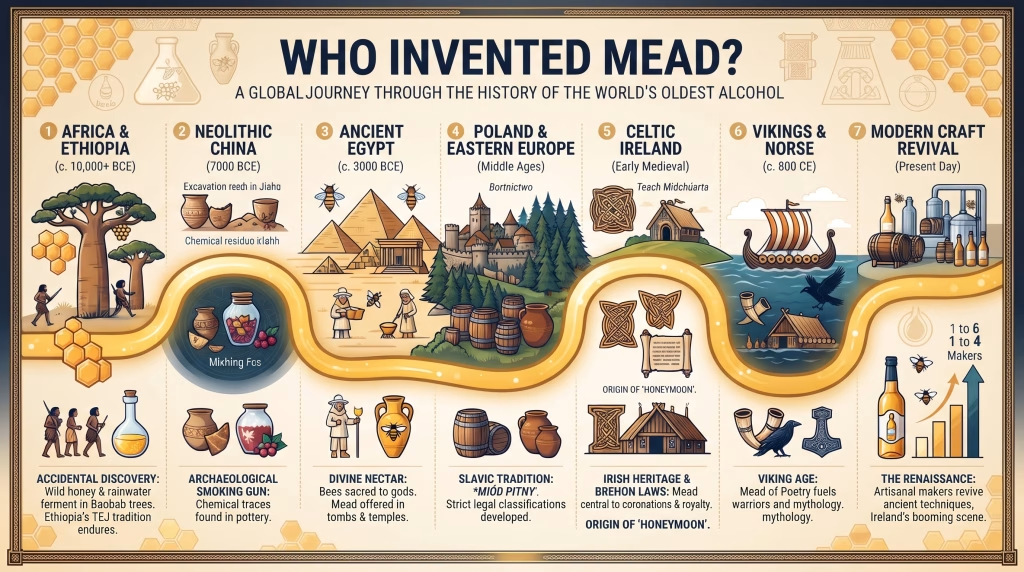
A Global Journey Through the History of the World’s Oldest Alcohol
For centuries, a single question has simmered in the back of taprooms and history departments alike: Who invented mead? Often celebrated as “honey wine,” mead is frequently romanticized alongside Viking longships or the misty hills of ancient Ireland. However, the true story of mead’s origins is far older and vastly more global than most realize.
From the Neolithic villages of China to the sacred texts of India, the horn-cups of the Vikings, the royal meads of Poland, and the flourishing modern revival of Irish mead, honey wine is the golden thread winding through the history of human civilization.
Quick Navigation: The History of Mead
The Accidental Beginning: Africa and Nature’s Vats
The Archaeological Proof: Neolithic China (7000 BCE)
Divine Nectar: Ancient Egypt, Greece, and India
Central and Eastern Europe: The Polish Miód Pitny Tradition
Irish Mead Heritage & The House of the Mead Circle at Tara
The Viking “Mead of Poetry” and Northern Europe
The Modern Craft Renaissance: Ireland’s Mead Revival
1. The “Accidental” Discovery: African and Ethiopian Origins
Long before humans mastered agriculture, nature was brewing mead in the hollows of African Baobab trees. During seasonal rains, wild beehives would flood, mixing raw honey with rainwater and wild airborne yeasts. Anthropologists believe hunter-gatherers discovered these naturally fermented vats, making mead the true ancestor of all fermented beverages.
The Ethiopian Tradition: T’ej
Alongside these ancient African roots, Ethiopia maintains a living, thousands-year-old mead tradition known as T’ej. This distinct ceremonial drink uses gesho (a bittering leaf from Rhamnus prinoides) instead of commercial yeast.
Tracing its lineage back to the Aksumite Empire, T’ej was once reserved exclusively for royalty. Today, it remains Ethiopia’s national drink, traditionally served in a flask-like vessel called a berele during weddings, festivals, and family gatherings.
2. The Archaeological Smoking Gun: Neolithic China (7000 BCE)
If we define the “inventor” as the first culture to intentionally manufacture and store a honey-based alcoholic drink, the title belongs to Neolithic China.
In the village of Jiahu (Henan Province), archaeologists uncovered pottery shards dating back to 7000 BCE. Molecular and chemical analysis published in the Proceedings of the National Academy of Sciences (PNAS) revealed traces of a prehistoric cocktail: honey, rice, and hawthorn berries. This landmark discovery predates the earliest known evidence of both grape wine and grain-based beer.
3. The Divine Nectar: Ancient Egypt, Greece, and India
As civilization expanded, mead held a sacred place among ancient deities and empires:
Ancient Egypt: Valued as pioneers of Mediterranean beekeeping, Egyptians viewed bees as sacred. Mead was utilized in religious rites, royal burials, and daily celebrations as a symbol of divine prosperity.
India: In the Rigveda (c. 1700 BCE)—one of humanity’s oldest sacred texts—mead is described as Soma, the divine drink granting immortality.
Greece & Eurasia: The ancient Greeks called mead Ambrosia or Hydromel, believing bees were messengers of the gods. Linguistically, the word “mead” shares ancient roots across Eurasia, from the Sanskrit Madhu to the Greek Methu.
4. Central and Eastern Europe: The Polish Miód Pitny Tradition
While other nations drifted heavily toward wine and beer, Poland and its Slavic neighbors preserved and perfected mead-making into an elite culinary art. Known as miód pitny (drinkable honey), Polish mead developed strict, time-honored classifications based on precise honey-to-water ratios:
Półtorak: 1 part honey to 0.5 parts water (extremely rich and aged for years).
Dwójniak: 1 part honey to 1 part water.
Trójniak: 1 part honey to 2 parts water.
Czwórniak: 1 part honey to 3 parts water.
Protected by European law as a unique cultural heritage (Traditional Speciality Guaranteed), the traditional Polish approach relies on long aging processes and specific honey ratios, proving that Central Europe is the heartbeat of traditional mead craftsmanship.
5. Irish Mead Heritage & The House of the Mead Circle at Tara
No exploration of mead is complete without looking at its prominent role in Irish history, mythology, and royal statecraft.
In Early Medieval Ireland, mead production was strictly regulated under the Brehon Laws. Known collectively as the Bechbretha (Bee-Judgments), these complex legal codes dictated everything from bee ownership to honey tributes.
Mead sat at the absolute center of Gaelic sovereignty. It was an essential feature at the coronations of Irish kings, symbolizing legitimacy, prosperity, and the binding pact between the ruler and the land. At the ancient Hill of Tara—the seat of the High Kings of Ireland—stood the legendary Teach Midchúarta, or the House of the Mead Circle. This magnificent banqueting hall hosted grand assemblies where tribal leaders and kings gathered in carefully ordered seating circles to drink mead, forge alliances, and uphold laws.
Irish folklore also gave birth to a beloved global tradition: the honeymoon. Newlyweds were traditionally gifted a moon’s cycle worth of mead by the bride’s family to ensure fertility and good fortune, locking honey wine permanently into wedding lore.
Related reading: The Rise of Real Mead in Ireland: Why Authenticity and Certification Matter
6. The Viking “Mead of Poetry” and Northern Europe
While popular culture links mead primarily to the Vikings, Scandinavian warriors were latecomers to a global tradition. To the Norse, however, mead held massive mythological weight. They revered the Mead of Poetry—a magical brew gifted by the gods that granted wisdom, scholarship, and poetic inspiration to whoever drank it.
7. The Modern Craft Renaissance: Ireland’s Mead Revival
For centuries after the old commercial houses faded out—such as Dublin’s historic 19th-century operations—mead was largely left to homebrewers and historical footnotes.
For a long time in modern Ireland, the category stood practically alone with just a single commercial standard-bearer. But over the last decade, a vibrant craft renaissance has taken root. Where only a single commercial mead maker operated just ten years ago, a new wave of independent producers has emerged across the island. By blending ancient recipes with modern winemaking techniques, these makers are transforming mead from a medieval novelty into a diverse category spanning crisp session styles, botanical sparklers, and fruit melomels—proving that Ireland’s oldest drink is firmly back on the map.
Frequently Asked Questions (FAQ)
Is mead the oldest alcohol in the world?
Yes. Archaeological evidence from Neolithic China (7000 BCE) proves that honey-based fermentation predates grape wine and grain beer.
Did the Vikings invent mead?
No. While Vikings are famous historical consumers of mead, it had already been brewed across Africa, Asia, and the Middle East for millennia before the Viking Age.
Was mead used in the coronation of Irish kings?
Yes. Mead was a ritual element in royal Gaelic coronations and grand assemblies, symbolizing sovereignty and prosperity—most famously celebrated at Tara’s historic Banqueting Hall, the House of the Mead Circle.
Conclusion: A Living Tradition
From the prehistoric clay pots of Neolithic China to the royal courts of Ethiopia, the strict laws of medieval Poland, the mythic halls of the Vikings, the coronation halls of Tara, and the booming craft meaderies of modern Ireland, mead has always been more than just alcohol—it is a liquid archive of human culture. Today, as contemporary makers revive ancient techniques and marry them with modern sustainability, the world’s oldest alcohol is experiencing a golden renaissance. Whether you enjoy a dry session style or a rich, aged traditional varietal, every sip connects you to a global lineage thousands of years in the making.
Sources & Further Reading
McGovern, P. E., et al. (2004). “Fermented beverages of pre- and proto-historic China.” PNAS.
The Brehon Laws: Bechbretha (Early Irish Law Series, Dublin Institute for Advanced Studies).
World History Encyclopedia: “Mead – The Drink of the Ancient World”.
Read More
-
Wedding Mead Barrel Debut: A Labor of Love at Belleek Castle
Next month, history and romance will blend in the most unique way possible at Be…
Read More about Wedding Mead Barrel Debut: A Labor of Love at Belleek Castle -
Experience the Wild Atlantic: Celtic Whiskey Shop Now Stocking Batch 1
For overseas enthusiasts of authentic craft beverages and native Irish ecology,…
Read More about Experience the Wild Atlantic: Celtic Whiskey Shop Now Stocking Batch 1 -
Irish Mead on sale today
IRELAND — Following its recent bottling last week, the highly anticipated First…
Read More about Irish Mead on sale today