Article
Halloween began in Ireland & Mead was involved from the start
Samhain
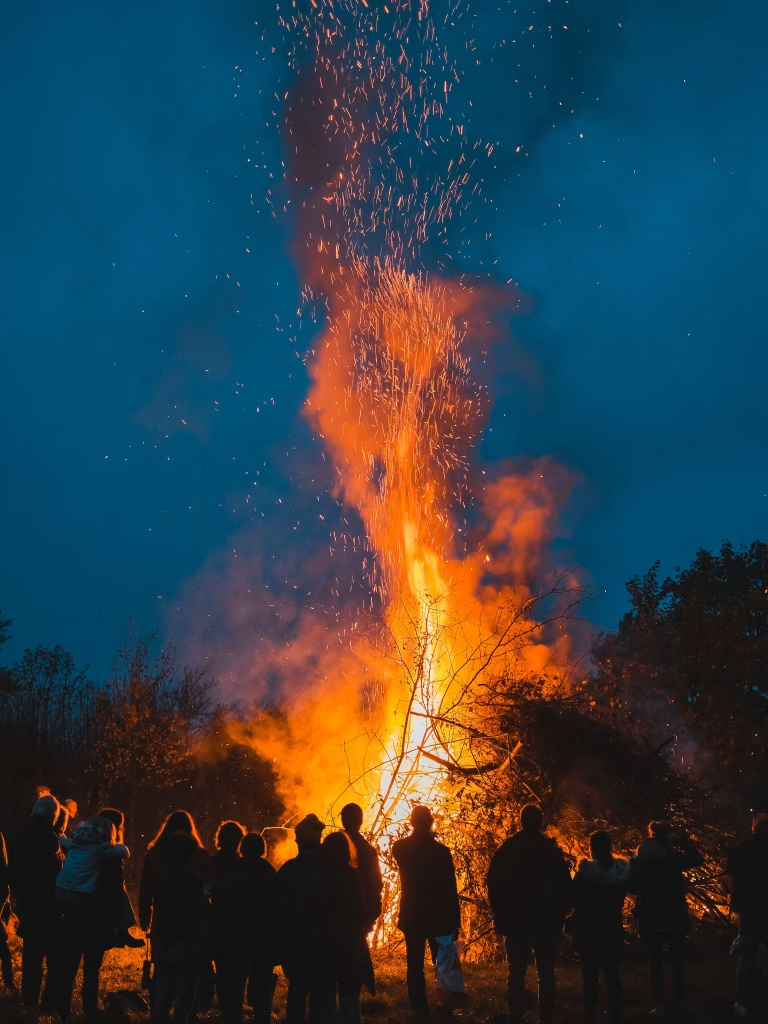
Every 31 October, hundreds of millions of people carve lanterns, dress up and go door to door. Few of them know they are keeping an Irish festival alive. Long before Halloween, there was Samhain, the great feast that marked the end of the Gaelic year.
Samhain was a time of fire, gathering and feasting. And in early Ireland, feasting meant mead: honey wine, the drink of kings, poets and warriors. This article traces how Samhain began, what it meant, how it travelled the world, and why we at Irish Mead still raise a glass of honey wine to it today.
What was Samhain?
Samhain (pronounced SOW-in) was the Gaelic festival marking the end of the harvest and the start of winter, held on 1 November and the night before it. The word survives in modern Irish as the name for November, and Halloween night is still Oíche Shamhna.
It was one of four great quarter days of the Gaelic year, alongside Imbolc, Bealtaine and Lúnasa. Samhain is named in the earliest Irish literature, from around the 9th century, and many of the great stories of Irish mythology begin on it. The Táin Bó Cúailnge, Ireland’s great epic, opens at Samhain.
The thin veil
The early Irish believed that at Samhain the sídhe, the ancient mounds of the Otherworld, stood open. The people of the hollow hills could walk among the living, and the living could stray into their world. One medieval tale, The Adventure of Nera, follows a young man who crosses into the Otherworld on Samhain night. Scholars at University College Cork see it as one of the best guides to what the festival meant.
It’s worth being clear on one point. Much of what we know comes from medieval monks writing centuries after pagan times, and Meath’s own heritage body notes there is no firm evidence that ancient Samhain was a festival of the dead. That link grew stronger later, when the Church placed All Saints’ and All Souls’ Days at the same time of year.
The fire at Tlachtga
The birthplace of Halloween is often said to be a low hill outside Athboy, Co. Meath. Its old name is Tlachtga; today it is the Hill of Ward, named after a 17th-century landowner.
The 17th-century historian Geoffrey Keating recorded that on the eve of Samhain every fire in Ireland was put out. A great fire was then lit at Tlachtga, and the people relit their hearths from it. Archaeologists have since found the hill was built in three phases, from the late Bronze Age around 1200 BC to the early medieval period, and excavations suggest it was used for feasting and ceremony.
Tara and the High Kings
Tlachtga lies about 12 miles from the Hill of Tara, seat of the High Kings of Ireland. The Feis Temro, the great royal assembly at Tara, was held at Samhain, and the medieval tales describe it lasting several days.
There is a family thread here too. In 1168, the High King Ruaidrí Ua Conchobair, Rory O’Connor, the last High King of Ireland, held a great gathering at Tlachtga itself. As O’Connors, that history feels close to home for us.
The fire still burns. Each Halloween, the Púca Festival in Trim and Athboy relights the Samhain fire on the hill.
Mead at the Samhain feast
Samhain was, above all, a feast, and in early Ireland the drink of the feast was mead. Honey wine was the most prized drink in the land: costly to make, rich in meaning and poured for kings.
The mead-circuit of Tara
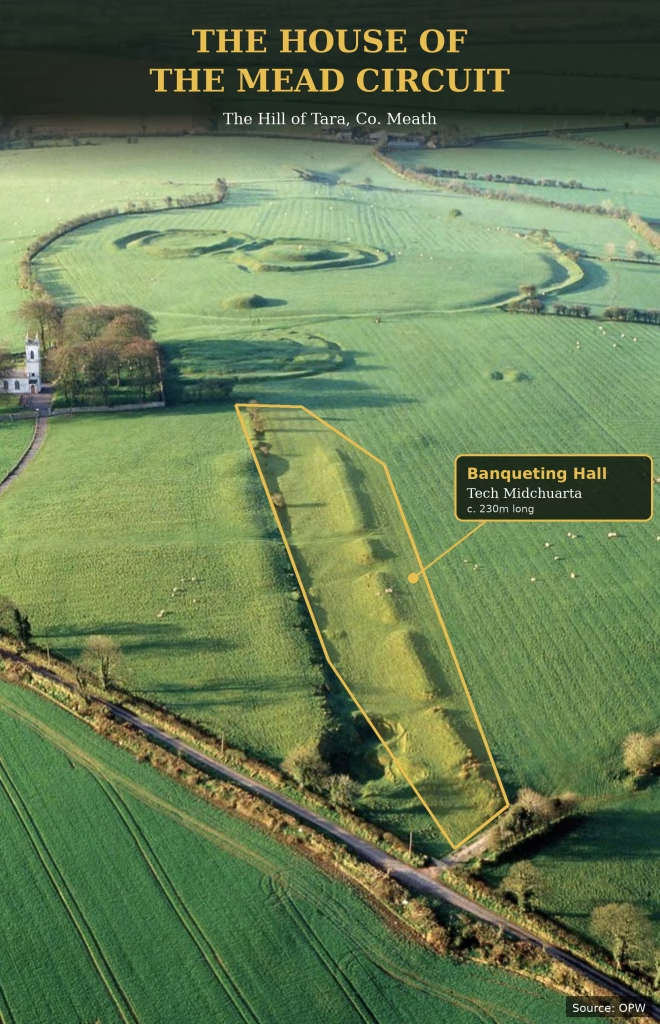
At Tara stood the Tech Midchúarta, the “House of the Mead-Circuit”. Medieval writers describe a great hall where mead passed around the company, with every guest seated by rank. Archaeologists now read the earthwork that bears the name as a ceremonial avenue, but the stories show how central mead was to kingship and to the royal feasts of Samhain. We tell that story in full in The Mead Hall of Tara.
A week of feasting in Ulster
The sagas of the Ulster Cycle are full of Samhain feasts. Serglige Con Culainn (“The Wasting Sickness of Cú Chulainn”) says the men of Ulster feasted for a full week: three days before Samhain, Samhain itself, and three days after.
The best-known of these tales is Mesca Ulad, “The Intoxication of the Ulstermen”, preserved in the 12th-century Book of Leinster. It is set at Samhain. The Ulstermen try to attend two feasts in one night, grow so drunk at the first that they march the wrong way across Ireland, and end up in Kerry among their enemies. You can read the Old Irish and English side by side in University College Cork’s edition.
The feast of the gods
Irish myth gives honey and brewing a divine side too. Goibniu, smith-god of the Tuatha Dé Danann, hosted the Fled Goibnenn, a feast whose drink kept the gods from age and sickness. It is legend, not history, but it shows how the early Irish thought of the feast cup: as something that held off the dark.
The texts don’t describe a fixed Samhain mead ritual. What they show clearly is that Samhain meant feasting, and that mead was the finest drink at any Irish feast.
Irish customs that survived
When Christianity came, Samhain did not vanish. The Church placed All Saints’ Day on 1 November, and the night before became All Hallows’ Eve, or Halloween. Many older customs carried on beneath the new name.
- Turnip lanterns. Long before pumpkins, Irish families carved faces into turnips and lit them with a coal or candle. The National Museum of Ireland – Country Life in Castlebar, Co. Mayo, holds a cast of a fearsome “ghost turnip” from Co. Donegal.
- Stingy Jack. The jack-o’-lantern takes its name from an Irish folk tale about a man who tricked the devil over a drink and was left to wander with only a coal in a turnip to light his way.
- Barmbrack. The fruit loaf baked for Halloween, with a ring hidden inside to tell the fortune of whoever found it.
- The púca. A shape-shifting spirit of Irish folklore, said to spoil any blackberries left on the bush after Samhain.
- Guising. Going house to house in disguise, the root of today’s trick-or-treating.
How Halloween crossed the Atlantic
In the 19th century, and above all after the Great Famine, millions of Irish people emigrated to North America. They brought Halloween with them. National Geographic traces how this wave of Irish emigrants and their folk tales helped shape the American jack-o’-lantern.
Turnips were scarce in America, but pumpkins were everywhere and far easier to carve. By the late 1800s, the pumpkin lantern had become the symbol of an Irish festival reborn. From there, Halloween spread around the world.
The Scots and Manx, fellow Gaels, kept Samhain traditions too, so Ireland shares the honour. But the fire at Tlachtga, the feasts at Tara and the turnip lanterns of the Irish countryside give Ireland a strong claim to be the home of Halloween.
Bringing mead back to the Irish table
Before whiskey. Before Guinness. There was mead. For centuries, honey wine was the drink that marked Ireland’s great occasions, and Samhain was chief among them. At Irish Mead, our aim is to bring it back.
We are beekeepers first. Our honey comes from our own hives in Co. Wicklow and Co. Mayo, including Inishturk Island, home of the Native Irish Honey Bee Sanctuary, where we conserve Ireland’s native black bee, Apis mellifera mellifera. No bees. No honey. No mead. No story.
- Wild Atlantic Mead, our flagship brand, is an 8% ABV honey wine made with heather and wildflower honey from our hives. It is certified Real Mead™ by the European Mead Makers Association, and is the only Irish meadery on that list.
- Mead Making Experiences let teams and groups make their own mead with us, at our venue or at their offices.
- Wedding mead brings the old tradition of honey wine to Irish weddings, from the ceremony cup to guest favours.
This Samhain, light a candle in a turnip, cut the barmbrack and pour a glass of Irish honey wine, as the High Kings did at Tara. Get in touch to order Wild Atlantic Mead or to book a Samhain mead-making experience for your team.
Sláinte.
Frequently asked questions
Did Halloween come from Ireland? Halloween grew out of Samhain, the Gaelic festival celebrated in Ireland and also in Scotland and the Isle of Man. Irish emigrants carried its customs to America in the 19th century, and from there it spread worldwide.
How do you pronounce Samhain? SOW-in, rhyming with “cow-in”. Halloween night in Irish is Oíche Shamhna (EE-ha HOW-na).
Where was Samhain celebrated in Ireland? The best-known sites are Tlachtga (the Hill of Ward) near Athboy and the Hill of Tara, both in Co. Meath.
What did people drink at Samhain? Samhain was a time of great feasts, and mead was the most prized drink at any early Irish feast. Ale was also widely drunk.
What is mead? Mead is a wine made by fermenting honey with water. It is one of the oldest alcoholic drinks in the world and was Ireland’s drink of kings.
Where can I buy Irish mead? Wild Atlantic Mead, made from our own Irish honey, is available through IrishMead.ie. and good off liciences.
Sources and further reading
- Samhain – Wikipedia
- Samhain – World History Encyclopedia
- Samhain in the Boyne Valley – Discover Boyne Valley
- Hill of Ward – Wikipedia
- Here Comes Summer!(?) – Department of Early and Medieval Irish, University College Cork
- Mesca Ulad – Wikipedia
- Mesca Ulad: Old Irish text with Irish and English translation – University College Cork
- Samhain – New World Encyclopedia
- The ancient fires that helped spark Halloween – The Irish Post
- The twisted transatlantic tale of American jack-o’-lanterns – National Geographic
Read More
-
The Mead Hall of Tara
The Mead Hall of Tara: Inside Teach Miodhchuarta, Ireland's House of the Mead-Ci…
Read More about The Mead Hall of Tara -
First Batch Bottled
Yesterday, we bottled the first batch of Wild Atlantic Mead, a beekeeper run Iri…
Read More about First Batch Bottled -
European Bee Awards
We're delighted to share some big news: the Inishturk Native Irish Honey Bee San…
Read More about European Bee Awards