Article
The Mead Hall of Tara
The Mead Hall of Tara: Inside Teach Miodhchuarta, Ireland’s House of the Mead-Circuit
Long before whiskey stills or porter breweries, the drink that bound Irish society together was mead. Nowhere is that clearer than on the Hill of Tara in Co. Meath, seat of the legendary High Kings, where a great earthwork still carries the name Teach Miodhchuarta – the House of the Mead-Circuit. For more than a thousand years, poets, scribes and scholars have imagined it as the greatest feasting hall in Ireland, a place where the whole order of society sat down together and the mead went round.
This is the story of that hall: what its name means, how big it is, what the medieval manuscripts say happened inside it, and why the simple act of passing a cup of mead from hand to hand mattered so much to the early Irish.
What does Teach Miodhchuarta mean?
The Old Irish name is Tech Midchúarta (modern Irish Teach Miodhchuarta or Teach Míochuarta), pronounced roughly “chakh mee-KOOR-ta”. It breaks down simply:
- tech / teach – house
- mid / miodh – mead
- cúairt / cuarta – a circuit or round
So it is not merely “the banqueting hall”, as English-language guidebooks often call it, but the house of the mead-circuit – the place where mead was carried round the company in a set order. The name became so prestigious that, as the historian P. W. Joyce noted, the banqueting halls of other great Irish houses were commonly called teach miodhchuarta after it [4].
Where it is, and how big it is
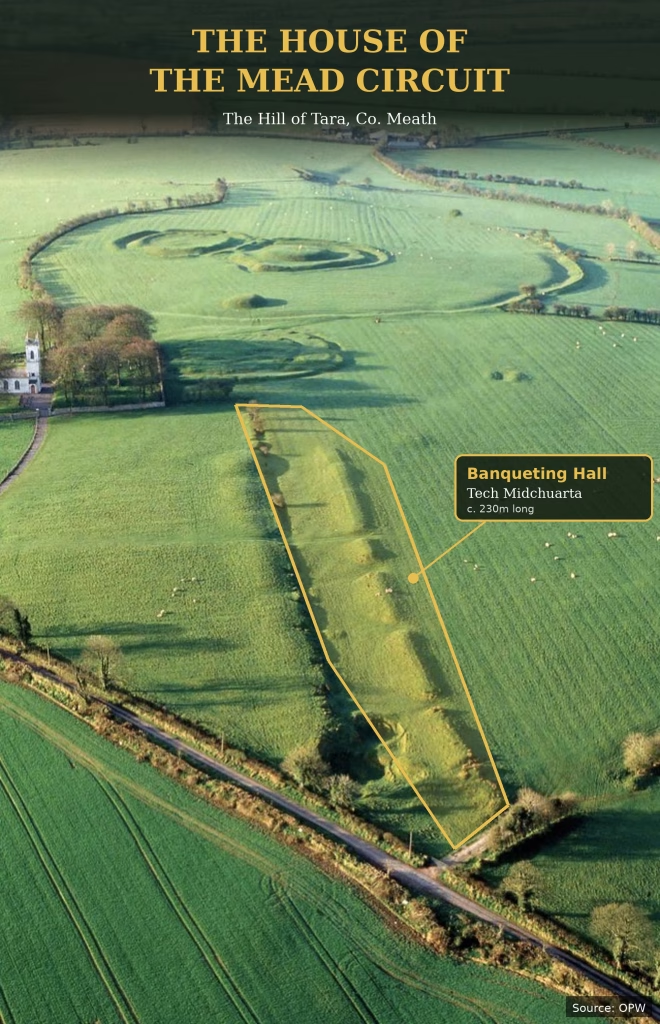
Teach Miodhchuarta lies on the northern slope of the Hill of Tara, running downhill from the summit. It is the only major monument on the hill that is not round or oval. What survives is a linear earthwork: two long, slightly curving but parallel banks with a sunken interior between them.
The most authoritative modern survey, by archaeologist Conor Newman of the Discovery Programme and the University of Galway, gives these dimensions [1][2]:
- Length: 203 metres (about 210 metres including its full extent)
- Width between the banks: 25 to 28 metres
- Rise from bottom to top: more than 8 metres
- Construction: soil was scraped from the middle and piled into the two side banks, so the interior sits noticeably below the surrounding ground
To put that in perspective, it is roughly the length of two international rugby pitches laid end to end. Nineteenth-century antiquarians, working from older measurements, recorded it as about 759 feet long by 46 feet wide and imagined it once roofed by a vast carved and painted timber building 45 feet high or more [4].
The hall the poets remembered
Our picture of the hall in use comes from medieval Irish literature, above all the Dindshenchas (the “lore of places”) and the great twelfth-century manuscripts.
The Metrical Dindshenchas poem on Tara, attributed to the tenth-century poet Cináed Ua hArtacáin, describes a hall of extraordinary scale: “thrice fifty stately couches there were, and fifty men to each shining couch”, a great hearth lit by blazing torches, lamps of brass, and fourteen doors [5]. Taken literally, that is seating for 7,500 – poetic exaggeration, certainly, but a measure of how the hall lived in the Irish imagination.
Two manuscripts go further and actually draw the seating plan:
- The Book of Leinster (Lebar na Núachongbála, second half of the 12th century), now in Trinity College Dublin, contains a diagram of the guests and staff of the feasting hall, followed by a poem, Suidigud Tigi Midchuarda – “The Arrangement of the Mead-Circuit House” [6][7]. The manuscript went on public display in 2025 following two years of conservation [8].
- The Book of Glendalough contains a schematic drawing of the hall, reproduced by George Petrie in his landmark 1839 study of Tara [1][3].
Seated by rank, served by rank
The Book of Leinster diagram is a rare snapshot of how early Irish society saw itself. There are no tables and no chairs. The king sits at the centre and a long spit runs down the middle of the hall [8][9]. Around it, every grade and profession has its allotted place – and its allotted cut of meat, with the best portion going to the king [8][9].
The labels name a remarkable cross-section of society: waiters, porters, fishermen, jesters, students, professional chess-players and musicians [9]. Strikingly, poets, musicians and scribes are ranked alongside the nobility [8] – a reflection of the enormous status the learned classes held in Gaelic Ireland. Law texts suggest that lower ranks sat on the ground at the front, with their backs against the knees of the nobles on the benches behind them [9].
Order was kept by a household officer called the reachtaire, the steward or “ruler of the feast”, who decided the sequence in which guests were served and the exact cut each received [9]. Precedence was serious business: the famous saga Fled Bricrenn (Bricriu’s Feast) turns on warriors fighting over the curadmír, the champion’s portion.
The circling of the mead
This is where the hall earns its name. Mead was not simply poured for each guest; it was shared. Tradition holds that a single vessel – typically a wooden mether (meadar), a cup with four corners or handles so it could be passed easily from hand to hand – went round the company in a fixed order, sunwise (deiseal), following the rank set out in the seating plan.
That circuit did three things at once:
- It displayed the social order. When you drank, and after whom, told everyone present exactly where you stood.
- It bound the company together. Drinking from the same cup was an act of trust, kinship and peace. Weapons were racked before guests took their seats [9], and the shared cup sealed the truce of the feast.
- It honoured the host. Mead came from honey, a precious, labour-intensive product of carefully kept hives – so carefully kept that early Ireland produced an entire law tract on bees, the 7th-century Bechbretha [11]. Serving mead freely was a mark of a lord’s wealth and generosity.
Mead, kingship and the goddess of Tara
Mead’s role at Tara went deeper than hospitality. Kingship there was bound up with Feis Temro, the Feast of Tara, an ancient inauguration rite [12]. In myth, the land’s sovereignty took the form of a woman who chose the rightful king by offering him a drink.
At Tara, that figure was Medb Lethderg, the sovereignty goddess said in legend to have been wife or lover to nine successive kings, and who gives her name to Ráth Maeve, the earthwork just south of the hill [13]. Her name is widely interpreted as “she who intoxicates” and traced to the Proto-Celtic word for mead, *medu- [12][13]. Some scholars have recently questioned that etymology [14], but the image of the king receiving the cup of sovereignty – and with it the land – remains one of the most powerful in Irish tradition.
To take the mead, in other words, was to take one’s place: as guest, as subject, or as king.
The last High King: an O’Connor story
For us, this history is personal. The last High King of Ireland was an O’Connor: Ruaidrí Ua Conchobair, known in English as Rory O’Connor. Born around 1116, he was King of Connacht from 1156 and High King of Ireland from 1166 until his death in 1198 [16][17]. His father, Toirdelbach Ua Conchobair (Turlough Mór O’Connor), had held the high kingship before him [16].
Ruaidrí’s reign marks the close of the age the Tara stories celebrate. He was inaugurated as High King in 1166, arguably the first to hold the title without opposition [16]. Within a few years the Anglo-Normans had landed, and under the Treaty of Windsor in 1175 he accepted Henry II as overlord in return for recognition as king of the Irish outside the English-held lands [17]. He spent his final years in religious retirement at Cong Abbey, died there in 1198, and was reinterred in 1207 at Clonmacnoise, beside the high altar [17][18].
There is a striking overlap in time. The Book of Leinster, with its seating plan of the mead-circuit house, was compiled in the second half of the twelfth century [7] – the very decades of Ruaidrí’s kingship. While the last High King ruled, Irish scribes were setting down in careful detail how a High King’s hall should be ordered and how the mead should go round. Tara had long ceased to be a royal residence by then, but its ideal still set the standard for Irish kingship: the king at the centre, his people around him, one cup passing between them.
As O’Connors making mead today – with our native Irish honey bees on Inishturk, off the coast of Mayo, the same county where Rory O’Connor ended his days at Cong – we feel that thread keenly. Reviving Irish mead is, for us, a way of keeping the mead-circuit turning.
Feasting hall or processional way? What archaeologists say
Here history and legend part company, and it is worth being honest about it. Modern archaeology does not support the idea of a single giant roofed hall on this spot.
Conor Newman’s analysis argues that the earthwork is better understood as a ceremonial processional avenue, probably built in the early medieval period, leading up to the summit and drawing the older monuments of Tara into a single choreographed approach [1][2]. A king-elect walking up its sunken interior would pass the tombs of his predecessors before emerging onto the sacred summit – a symbolic journey into kingship. Other scholars have examined how the medieval writers themselves understood the hall, and how and when the name Tech Midchúarta came to be attached to the earthwork [10].
The elaborate descriptions of the great hall, then, come largely from writers of the 10th to 12th centuries looking back on a golden age. But that does not make them worthless. They tell us, with great precision, what the learned classes of medieval Ireland believed a royal feast should look like – and at its heart was the circling of the mead.
Why the mead circuit still matters
Strip away the gold and the thousand warriors, and the idea at the centre of Teach Miodhchuarta is a simple one: a company gathered together, one cup passing from hand to hand, everyone included in the round. It is an idea that has never really left Irish life – it lives on whenever we stand a round, raise a toast or pass a glass.
It is also why mead remains such a natural fit for the occasions that matter most. At a wedding, sharing a cup of mead echoes the ancient image of a union sealed with a drink. In a workplace, making and sharing mead together is a modern take on the old mead-circuit: a team at one table, each with a part to play. That is why we provide bespoke Wedding Mead.
Visiting the Hill of Tara
The Hill of Tara lies near Navan in Co. Meath, about 45 minutes from Dublin. The hill is open to walk, and the outline of Teach Miodhchuarta is easy to trace on the northern slope below the summit. The site is managed by the Office of Public Works; check Heritage Ireland for current visitor-centre opening times and guided tours. Wear sturdy footwear – the banks are steep and often wet.
Frequently asked questions
What is the Mead Hall of Tara? Teach Miodhchuarta, the “House of the Mead-Circuit”, is a large linear earthwork on the Hill of Tara, Co. Meath. Medieval Irish texts describe it as the feasting hall of the High Kings, where mead was passed round the company by rank.
How big is Teach Miodhchuarta? About 203 metres long, with banks 25–28 metres apart, rising more than 8 metres from end to end.
Was there really a mead hall at Tara? The great roofed hall described in medieval manuscripts was probably an idealised memory. Archaeologists now interpret the earthwork as a ceremonial processional way, likely early medieval in date.
What is a mether? A traditional Irish wooden drinking vessel, usually with four corners, designed for passing mead from person to person.
Why was mead important in early Ireland? Mead was a prestige drink made from precious honey. It was central to feasting, hospitality and kingship, and in myth the sovereignty of the land was conferred through a drink offered to the king.
Who was the last High King of Ireland? Ruaidrí Ua Conchobair (Rory O’Connor), King of Connacht and High King from 1166 to 1198. He retired to Cong Abbey, Co. Mayo, and is buried at Clonmacnoise.
References
‘Cong Abbey’. Wikipedia. https://en.wikipedia.org/wiki/Cong_Abbey: Inside Teach Miodhchuarta, Ireland’s House of the Mead-Circuit
Newman, C. (2007) ‘Procession and symbolism at Tara: analysis of Tech Midchúarta (the “Banqueting Hall”) in the context of the sacral campus’, Oxford Journal of Archaeology, 26(4), pp. 415–438. https://onlinelibrary.wiley.com/doi/abs/10.1111/j.1468-0092.2007.00291.x (open-access copy: University of Galway Research Repository)
Newman, C. (1997) Tara: An Archaeological Survey. Discovery Programme Monographs 2. Dublin: Royal Irish Academy / Discovery Programme.
Petrie, G. (1839) ‘On the History and Antiquities of Tara Hill’, Transactions of the Royal Irish Academy, 18.
Joyce, P. W. (1903) A Social History of Ancient Ireland. London: Longmans, Green & Co. Online: https://www.libraryireland.com/SocialHistoryAncientIreland/III-XVI-7.php
Gwynn, E. (ed. and trans.) (1903) The Metrical Dindshenchas, Part I (Todd Lecture Series VIII). Dublin: Royal Irish Academy. Online via CELT, University College Cork: https://celt.ucc.ie
Best, R. I., Bergin, O. and O’Brien, M. A. (eds) (1954–83) The Book of Leinster, formerly Lebar na Núachongbála. Dublin: Dublin Institute for Advanced Studies. Tech Midchúarda text online: https://celt.ucc.ie/published/G800011A/text008.html
Contents of the Book of Leinster (fol. 29a: diagram of the feasting hall; poem Suidigud Tigi Midchuarda). https://en.wikipedia.org/wiki/Contents_of_the_Book_of_Leinster
The Irish Times (21 May 2025) ‘The “Wikipedia of the age”: Restored 900-year-old Book of Leinster manuscript goes on first public display in Dublin’. https://www.irishtimes.com/culture/books/2025/05/21/the-wikipedia-of-the-age-myths-legends-and-seating-arrangements-at-the-hill-of-tara-in-900-year-old-manuscript-on-public-display/
RTÉ Brainstorm (30 Aug 2024) ‘Eating, drinking, farting: your guide to medieval Gaelic banquets’. https://www.rte.ie/brainstorm/2024/0830/1467473-medieval-gaelic-banquets-feasts-tech-midchuarta-banqueting-hall-hill-of-tara/
Downey, C. ‘Dindṡenchas and the Tech Midchúarta’. https://www.semanticscholar.org/paper/DINDS%CC%87ENCHAS-AND-THE-TECH-MIDCH%C3%9AARTA-Downey/66ac9e8c346526f7fda59b0e1c9a86591273273c
Charles-Edwards, T. and Kelly, F. (1983) Bechbretha: An Old Irish Law-Tract on Bee-Keeping. Dublin: Dublin Institute for Advanced Studies.
‘Kingship of Tara’ and ‘Medb’. Wikipedia. https://en.wikipedia.org/wiki/Kingship_of_Tara ; https://en.wikipedia.org/wiki/Medb
‘Rath Meave’. Wikipedia. https://en.wikipedia.org/wiki/Rath_Meave
‘Medb “the intoxicating one”? (Re-)constructing the past through etymology’. https://www.academia.edu/17511465/Medb_the_intoxicating_one_Re_constructing_the_past_through_etymology
Schot, R., Newman, C. and Bhreathnach, E. (eds) (2011) Landscapes of Cult and Kingship. Dublin: Four Courts Press. (Further reading)
‘Ruaidrí Ua Conchobair’. Wikipedia. https://en.wikipedia.org/wiki/Ruaidr%C3%AD_Ua_Conchobair
Dictionary of Irish Biography, ‘Ua Conchobair, Ruaidrí’. Royal Irish Academy. https://www.dib.ie/biography/ua-conchobair-ruaidri-a8725
Long before whiskey stills or porter breweries, the drink that bound Irish society together was mead. Nowhere is that clearer than on the Hill of Tara in Co. Meath, seat of the legendary High Kings, where a great earthwork still carries the name Teach Miodhchuarta – the House of the Mead-Circuit. For more than a thousand years, poets, scribes and scholars have imagined it as the greatest feasting hall in Ireland, a place where the whole order of society sat down together and the mead went round.
This is the story of that hall: what its name means, how big it is, what the medieval manuscripts say happened inside it, and why the simple act of passing a cup of mead from hand to hand mattered so much to the early Irish.
What does Teach Miodhchuarta mean?
The Old Irish name is Tech Midchúarta (modern Irish Teach Miodhchuarta or Teach Míochuarta), pronounced roughly “chakh mee-KOOR-ta”. It breaks down simply:
- tech / teach – house
- mid / miodh – mead
- cúairt / cuarta – a circuit or round
So it is not merely “the banqueting hall”, as English-language guidebooks often call it, but the house of the mead-circuit – the place where mead was carried round the company in a set order. The name became so prestigious that, as the historian P. W. Joyce noted, the banqueting halls of other great Irish houses were commonly called teach miodhchuarta after it [4].
Where it is, and how big it is
Teach Miodhchuarta lies on the northern slope of the Hill of Tara, running downhill from the summit. It is the only major monument on the hill that is not round or oval. What survives is a linear earthwork: two long, slightly curving but parallel banks with a sunken interior between them.
The most authoritative modern survey, by archaeologist Conor Newman of the Discovery Programme and the University of Galway, gives these dimensions [1][2]:
- Length: 203 metres (about 210 metres including its full extent)
- Width between the banks: 25 to 28 metres
- Rise from bottom to top: more than 8 metres
- Construction: soil was scraped from the middle and piled into the two side banks, so the interior sits noticeably below the surrounding ground
To put that in perspective, it is roughly the length of two international rugby pitches laid end to end. Nineteenth-century antiquarians, working from older measurements, recorded it as about 759 feet long by 46 feet wide and imagined it once roofed by a vast carved and painted timber building 45 feet high or more [4].
The hall the poets remembered
Our picture of the hall in use comes from medieval Irish literature, above all the Dindshenchas (the “lore of places”) and the great twelfth-century manuscripts.
The Metrical Dindshenchas poem on Tara, attributed to the tenth-century poet Cináed Ua hArtacáin, describes a hall of extraordinary scale: “thrice fifty stately couches there were, and fifty men to each shining couch”, a great hearth lit by blazing torches, lamps of brass, and fourteen doors [5]. Taken literally, that is seating for 7,500 – poetic exaggeration, certainly, but a measure of how the hall lived in the Irish imagination.
Two manuscripts go further and actually draw the seating plan:
- The Book of Leinster (Lebar na Núachongbála, second half of the 12th century), now in Trinity College Dublin, contains a diagram of the guests and staff of the feasting hall, followed by a poem, Suidigud Tigi Midchuarda – “The Arrangement of the Mead-Circuit House” [6][7]. The manuscript went on public display in 2025 following two years of conservation [8].
- The Book of Glendalough contains a schematic drawing of the hall, reproduced by George Petrie in his landmark 1839 study of Tara [1][3].
Seated by rank, served by rank
The Book of Leinster diagram is a rare snapshot of how early Irish society saw itself. There are no tables and no chairs. The king sits at the centre and a long spit runs down the middle of the hall [8][9]. Around it, every grade and profession has its allotted place – and its allotted cut of meat, with the best portion going to the king [8][9].
The labels name a remarkable cross-section of society: waiters, porters, fishermen, jesters, students, professional chess-players and musicians [9]. Strikingly, poets, musicians and scribes are ranked alongside the nobility [8] – a reflection of the enormous status the learned classes held in Gaelic Ireland. Law texts suggest that lower ranks sat on the ground at the front, with their backs against the knees of the nobles on the benches behind them [9].
Order was kept by a household officer called the reachtaire, the steward or “ruler of the feast”, who decided the sequence in which guests were served and the exact cut each received [9]. Precedence was serious business: the famous saga Fled Bricrenn (Bricriu’s Feast) turns on warriors fighting over the curadmír, the champion’s portion.
The circling of the mead
This is where the hall earns its name. Mead was not simply poured for each guest; it was shared. Tradition holds that a single vessel – typically a wooden mether (meadar), a cup with four corners or handles so it could be passed easily from hand to hand – went round the company in a fixed order, sunwise (deiseal), following the rank set out in the seating plan.
That circuit did three things at once:
- It displayed the social order. When you drank, and after whom, told everyone present exactly where you stood.
- It bound the company together. Drinking from the same cup was an act of trust, kinship and peace. Weapons were racked before guests took their seats [9], and the shared cup sealed the truce of the feast.
- It honoured the host. Mead came from honey, a precious, labour-intensive product of carefully kept hives – so carefully kept that early Ireland produced an entire law tract on bees, the 7th-century Bechbretha [11]. Serving mead freely was a mark of a lord’s wealth and generosity.
Mead, kingship and the goddess of Tara
Mead’s role at Tara went deeper than hospitality. Kingship there was bound up with Feis Temro, the Feast of Tara, an ancient inauguration rite [12]. In myth, the land’s sovereignty took the form of a woman who chose the rightful king by offering him a drink.
At Tara, that figure was Medb Lethderg, the sovereignty goddess said in legend to have been wife or lover to nine successive kings, and who gives her name to Ráth Maeve, the earthwork just south of the hill [13]. Her name is widely interpreted as “she who intoxicates” and traced to the Proto-Celtic word for mead, *medu- [12][13]. Some scholars have recently questioned that etymology [14], but the image of the king receiving the cup of sovereignty – and with it the land – remains one of the most powerful in Irish tradition.
To take the mead, in other words, was to take one’s place: as guest, as subject, or as king.
The last High King: an O’Connor story
For us, this history is personal. The last High King of Ireland was an O’Connor: Ruaidrí Ua Conchobair, known in English as Rory O’Connor. Born around 1116, he was King of Connacht from 1156 and High King of Ireland from 1166 until his death in 1198 [16][17]. His father, Toirdelbach Ua Conchobair (Turlough Mór O’Connor), had held the high kingship before him [16].
Ruaidrí’s reign marks the close of the age the Tara stories celebrate. He was inaugurated as High King in 1166, arguably the first to hold the title without opposition [16]. Within a few years the Anglo-Normans had landed, and under the Treaty of Windsor in 1175 he accepted Henry II as overlord in return for recognition as king of the Irish outside the English-held lands [17]. He spent his final years in religious retirement at Cong Abbey, died there in 1198, and was reinterred in 1207 at Clonmacnoise, beside the high altar [17][18].
There is a striking overlap in time. The Book of Leinster, with its seating plan of the mead-circuit house, was compiled in the second half of the twelfth century [7] – the very decades of Ruaidrí’s kingship. While the last High King ruled, Irish scribes were setting down in careful detail how a High King’s hall should be ordered and how the mead should go round. Tara had long ceased to be a royal residence by then, but its ideal still set the standard for Irish kingship: the king at the centre, his people around him, one cup passing between them.
As O’Connors making mead today – with our native Irish honey bees on Inishturk, off the coast of Mayo, the same county where Rory O’Connor ended his days at Cong – we feel that thread keenly. Reviving Irish mead is, for us, a way of keeping the mead-circuit turning.
Feasting hall or processional way? What archaeologists say
Here history and legend part company, and it is worth being honest about it. Modern archaeology does not support the idea of a single giant roofed hall on this spot.
Conor Newman’s analysis argues that the earthwork is better understood as a ceremonial processional avenue, probably built in the early medieval period, leading up to the summit and drawing the older monuments of Tara into a single choreographed approach [1][2]. A king-elect walking up its sunken interior would pass the tombs of his predecessors before emerging onto the sacred summit – a symbolic journey into kingship. Other scholars have examined how the medieval writers themselves understood the hall, and how and when the name Tech Midchúarta came to be attached to the earthwork [10].
The elaborate descriptions of the great hall, then, come largely from writers of the 10th to 12th centuries looking back on a golden age. But that does not make them worthless. They tell us, with great precision, what the learned classes of medieval Ireland believed a royal feast should look like – and at its heart was the circling of the mead.
Why the mead circuit still matters
Strip away the gold and the thousand warriors, and the idea at the centre of Teach Miodhchuarta is a simple one: a company gathered together, one cup passing from hand to hand, everyone included in the round. It is an idea that has never really left Irish life – it lives on whenever we stand a round, raise a toast or pass a glass.
It is also why mead remains such a natural fit for the occasions that matter most. At a wedding, sharing a cup of mead echoes the ancient image of a union sealed with a drink. In a workplace, making and sharing mead together is a modern take on the old mead-circuit: a team at one table, each with a part to play. That is why we provide bespoke Wedding Mead.
Visiting the Hill of Tara
The Hill of Tara lies near Navan in Co. Meath, about 45 minutes from Dublin. The hill is open to walk, and the outline of Teach Miodhchuarta is easy to trace on the northern slope below the summit. The site is managed by the Office of Public Works; check Heritage Ireland for current visitor-centre opening times and guided tours. Wear sturdy footwear – the banks are steep and often wet.
Frequently asked questions
What is the Mead Hall of Tara? Teach Miodhchuarta, the “House of the Mead-Circuit”, is a large linear earthwork on the Hill of Tara, Co. Meath. Medieval Irish texts describe it as the feasting hall of the High Kings, where mead was passed round the company by rank.
How big is Teach Miodhchuarta? About 203 metres long, with banks 25–28 metres apart, rising more than 8 metres from end to end.
Was there really a mead hall at Tara? The great roofed hall described in medieval manuscripts was probably an idealised memory. Archaeologists now interpret the earthwork as a ceremonial processional way, likely early medieval in date.
What is a mether? A traditional Irish wooden drinking vessel, usually with four corners, designed for passing mead from person to person.
Why was mead important in early Ireland? Mead was a prestige drink made from precious honey. It was central to feasting, hospitality and kingship, and in myth the sovereignty of the land was conferred through a drink offered to the king.
Who was the last High King of Ireland? Ruaidrí Ua Conchobair (Rory O’Connor), King of Connacht and High King from 1166 to 1198. He retired to Cong Abbey, Co. Mayo, and is buried at Clonmacnoise.
References
- Newman, C. (2007) ‘Procession and symbolism at Tara: analysis of Tech Midchúarta (the “Banqueting Hall”) in the context of the sacral campus’, Oxford Journal of Archaeology, 26(4), pp. 415–438. https://onlinelibrary.wiley.com/doi/abs/10.1111/j.1468-0092.2007.00291.x (open-access copy: University of Galway Research Repository)
- Newman, C. (1997) Tara: An Archaeological Survey. Discovery Programme Monographs 2. Dublin: Royal Irish Academy / Discovery Programme.
- Petrie, G. (1839) ‘On the History and Antiquities of Tara Hill’, Transactions of the Royal Irish Academy, 18.
- Joyce, P. W. (1903) A Social History of Ancient Ireland. London: Longmans, Green & Co. Online: https://www.libraryireland.com/SocialHistoryAncientIreland/III-XVI-7.php
- Gwynn, E. (ed. and trans.) (1903) The Metrical Dindshenchas, Part I (Todd Lecture Series VIII). Dublin: Royal Irish Academy. Online via CELT, University College Cork: https://celt.ucc.ie
- Best, R. I., Bergin, O. and O’Brien, M. A. (eds) (1954–83) The Book of Leinster, formerly Lebar na Núachongbála. Dublin: Dublin Institute for Advanced Studies. Tech Midchúarda text online: https://celt.ucc.ie/published/G800011A/text008.html
- Contents of the Book of Leinster (fol. 29a: diagram of the feasting hall; poem Suidigud Tigi Midchuarda). https://en.wikipedia.org/wiki/Contents_of_the_Book_of_Leinster
- The Irish Times (21 May 2025) ‘The “Wikipedia of the age”: Restored 900-year-old Book of Leinster manuscript goes on first public display in Dublin’. https://www.irishtimes.com/culture/books/2025/05/21/the-wikipedia-of-the-age-myths-legends-and-seating-arrangements-at-the-hill-of-tara-in-900-year-old-manuscript-on-public-display/
- RTÉ Brainstorm (30 Aug 2024) ‘Eating, drinking, farting: your guide to medieval Gaelic banquets’. https://www.rte.ie/brainstorm/2024/0830/1467473-medieval-gaelic-banquets-feasts-tech-midchuarta-banqueting-hall-hill-of-tara/
- Downey, C. ‘Dindṡenchas and the Tech Midchúarta’. https://www.semanticscholar.org/paper/DINDS%CC%87ENCHAS-AND-THE-TECH-MIDCH%C3%9AARTA-Downey/66ac9e8c346526f7fda59b0e1c9a86591273273c
- Charles-Edwards, T. and Kelly, F. (1983) Bechbretha: An Old Irish Law-Tract on Bee-Keeping. Dublin: Dublin Institute for Advanced Studies.
- ‘Kingship of Tara’ and ‘Medb’. Wikipedia. https://en.wikipedia.org/wiki/Kingship_of_Tara ; https://en.wikipedia.org/wiki/Medb
- ‘Rath Meave’. Wikipedia. https://en.wikipedia.org/wiki/Rath_Meave
- ‘Medb “the intoxicating one”? (Re-)constructing the past through etymology’. https://www.academia.edu/17511465/Medb_the_intoxicating_one_Re_constructing_the_past_through_etymology
- Schot, R., Newman, C. and Bhreathnach, E. (eds) (2011) Landscapes of Cult and Kingship. Dublin: Four Courts Press. (Further reading)
- ‘Ruaidrí Ua Conchobair’. Wikipedia. https://en.wikipedia.org/wiki/Ruaidr%C3%AD_Ua_Conchobair
- Dictionary of Irish Biography, ‘Ua Conchobair, Ruaidrí’. Royal Irish Academy. https://www.dib.ie/biography/ua-conchobair-ruaidri-a8725
- ‘Cong Abbey’. Wikipedia. https://en.wikipedia.org/wiki/Cong_Abbey
Read More
-
Halloween began in Ireland & Mead was involved from the start
Samhain Every 31 October, hundreds of millions of people carve lanterns, dress u…
Read More about Halloween began in Ireland & Mead was involved from the start -
First Batch Bottled
Yesterday, we bottled the first batch of Wild Atlantic Mead, a beekeeper run Iri…
Read More about First Batch Bottled -
European Bee Awards
We're delighted to share some big news: the Inishturk Native Irish Honey Bee San…
Read More about European Bee Awards